

Your Profit Starts at Zero Moment of Pickup: 5 of The Best Free Inventory Sources for Your Resale Business
The Thrifty Millionaire | Millionaires Never Pay Full Price.
A resale business can start with a pile of unwanted belongings and a little curiosity. But turning it into dependable income takes more than finding something cheap.
Your profit starts with what you pay—and what it takes to get an item sold.
Pay too much, and fees eat your margin. Collect everything marked “free,” and your garage fills up with someone else’s problems.
The opportunity sits between those extremes: useful items, proven demand, little or no acquisition cost, and a repeatable way to find more.
Here are five free inventory sources you can build into a sourcing routine. Availability varies, so build several channels instead of depending on one.
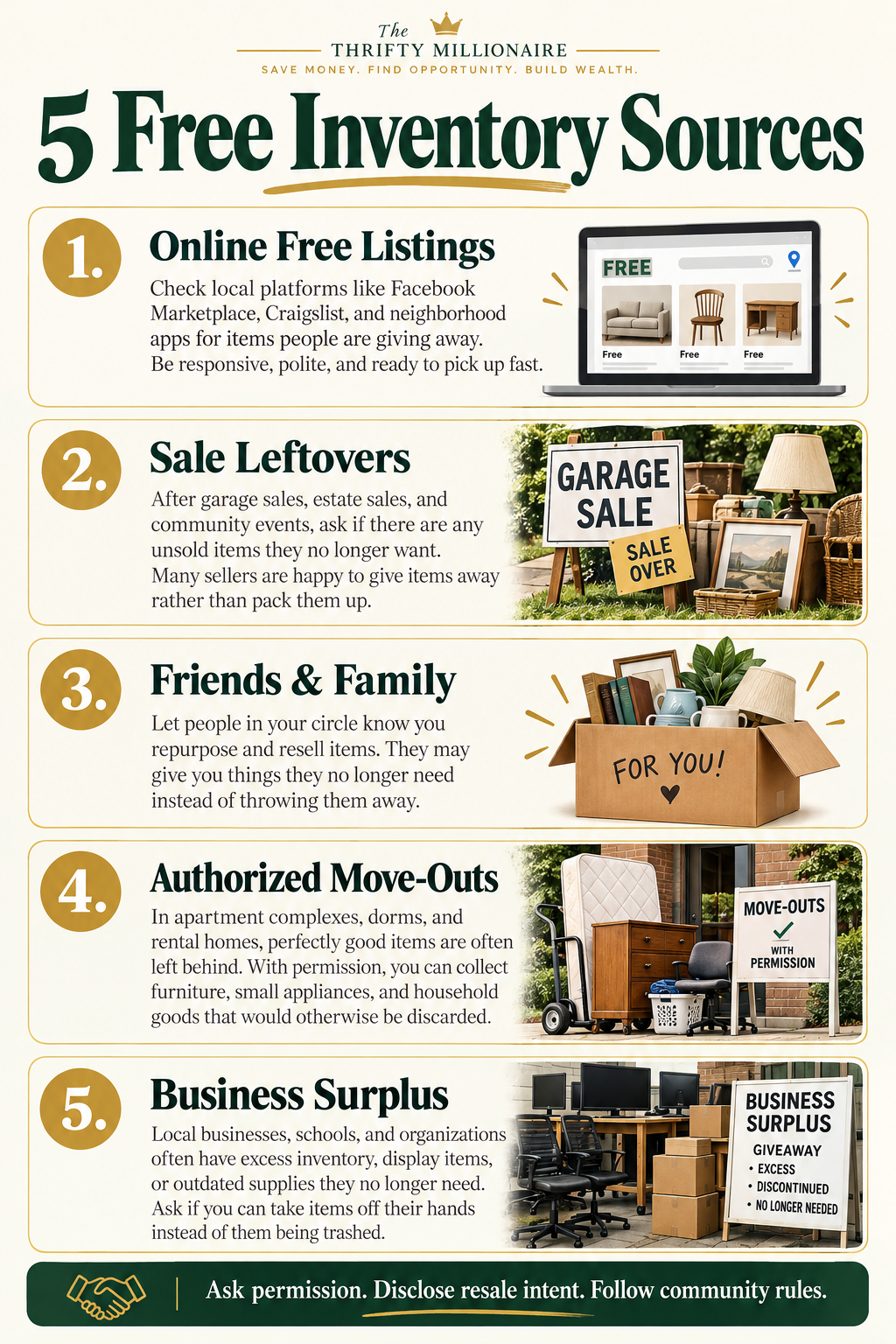
1. Online Free Listings and Neighborhood Giveaway Groups
Start with Facebook Marketplace’s free listings, Craigslist’s free section, Freecycle, and neighborhood gifting groups.
People move, downsize, replace furniture, and clear closets. Sometimes a dependable pickup is more valuable to them than collecting a few dollars.
Look for: complete board games, identifiable tools, quality clothing, small solid-wood furniture, and working household items you can inspect.
Make it repeatable:
- Check nearby listings at two set times each day.
- Search “free,” “moving,” “porch pickup,” and specific categories you know.
- Keep your pickup radius small.
- Offer a specific pickup window and show up when promised.
Be upfront that you resell. Freecycle requires advance disclosure in groups that permit resale. Buy Nothing emphasizes trust and disclosure; follow the community’s rules and respect the giver’s choice. Do not post sales pitches in gifting groups.
Thrifty Millionaire rule: A free $15 item an hour away can be an expensive distraction.
2. Garage-Sale and Moving-Sale Leftovers
The end of a sale creates a different problem for the seller: everything still sitting in the driveway needs to go somewhere.
Ask politely whether there are items they already intend to give away. A priced item remains a priced item until the owner explicitly offers it free.
Look for: books worth selling individually or in themed lots, complete hobby supplies, older décor, clothing, and overlooked accessories.
Make it repeatable:
- Plan a short neighborhood route.
- Visit near the advertised closing time.
- Ask permission to leave your contact details for future leftovers.
- Tell organizers which categories you can actually accept.
Estate-sale organizers may also become contacts, but unsold goods belong to the owner or estate. Get approval from someone authorized to give them away.
Thrifty Millionaire rule: Offer a useful pickup service, and let the owner decide what leaves.
3. A Friends-and-Family Decluttering Network
Your first inventory network may already be in your phone.
Friends, relatives, coworkers, and neighbors regularly replace things that still have value. Let them know which items you accept, that you plan to resell them, and that giving is entirely optional.
Look for: outgrown clothing, hobby equipment, games, tools, and household décor.
Make it repeatable:
- Choose two or three categories you understand.
- Offer a monthly pickup day.
- Ask people to send photos before setting items aside.
- Thank them and keep pickup easy.
Make the arrangement explicit. If someone expects a share of the sale, that is a consignment arrangement rather than free inventory. Agree on the terms before taking possession.
Thrifty Millionaire rule: Clear expectations protect relationships—and relationships create repeat opportunities.

4. Authorized Move-Out and Curbside Giveaways
Moving deadlines create urgency. A useful shelf, desk, or box of kitchenware may be available free because its owner needs it gone today.
Look for clearly marked free piles, community giveaway events, and pickups arranged directly with owners or property managers.
Look for: clean hard-surface furniture, shelving, intact storage items, and easy-to-inspect household goods.
Make it repeatable:
- Ask property managers whether they can connect you with residents who want to give items away.
- Watch neighborhood move-out announcements.
- Coordinate recurring pickups with explicit permission.
- Bring measurements, straps, and enough vehicle space.
A location near a dumpster does not establish permission. Confirm ownership and local collection rules before taking anything. Leave contaminated, infested, or unsafe items behind.
Thrifty Millionaire rule: Know where a bulky item will go—and how you will sell it—before loading it.
5. Local Business Surplus Relationships
Businesses sometimes replace fixtures, clear display materials, or retire usable equipment. A reliable person who collects approved surplus can solve a small but recurring problem.
Potential contacts include independent retailers, offices, repair shops, and property-staging businesses.
Look for: display stands, shelving, frames, discontinued samples, and usable office accessories.
Make it repeatable:
- Approach a few nearby businesses with a specific list of items you accept.
- Ask who can authorize disposal or gifting.
- Offer scheduled pickup after a reset or clear-out.
- Confirm which items may be resold and any restrictions.
Do not assume surplus is free or available. Avoid data-bearing devices unless the business has handled data removal and authorized transfer. Never claim a charitable tax deduction on the giver’s behalf.
Thrifty Millionaire rule: Being reliable can create better sourcing access than being the first person to ask.
Free Inventory Still Has a Cost
Before pickup, ask: What will this realistically leave me after the sale?
Use comparable sold items, matching brand, model, condition, completeness, and shipping terms. Asking prices show what sellers hope to receive. eBay Product Research can help you investigate actual sales.
Here is an illustrative transaction—not a typical earnings claim:
| Item | Amount |
|---|---|
| Sale proceeds, including shipping collected | $50 |
| Inventory purchase cost | $0 |
| Assumed platform and payment fees | −$8 |
| Shipping label | −$10 |
| Cleaning and packaging | −$3 |
| Allocated pickup expense | −$4 |
| Contribution before labor, overhead, returns, and taxes | $25 |
If the entire process takes one hour, that leaves $25 before the remaining costs. If it takes three hours, the same contribution works out to about $8.33 per hour.
A free acquisition does not make your time free.
For paid inventory, work backward:
Maximum purchase price = expected sale proceeds − all other expected costs − target profit.
Using the same example, a $20 target contribution leaves only $5 available to buy the item.
Match the Item to the Buyer
Think of platform choice as part of sourcing:
| Inventory | Potential selling channel |
|---|---|
| Identifiable collectibles, tools, parts, and niche goods | eBay |
| Bulky furniture and items suited to local pickup | Facebook Marketplace |
| Qualifying vintage décor, clothing, and permitted supplies | Etsy |
| Fashion with a clear style, brand, or vintage appeal | Depop |
Etsy is not a general used-goods marketplace. Its vintage category requires items to be at least 20 years old; ordinary secondhand goods do not automatically qualify.
Check each platform’s current rules and fees before listing. Verify authenticity, check applicable recall information, and disclose defects. If you cannot establish that an item is safe, authentic, and permitted, pass.

Build a Pipeline, Then Build Wealth
Start with two categories and a manageable pickup radius. Check listings daily, build one new sourcing relationship each week, and schedule listing time before collecting more.
Track the source, pickup cost, preparation time, listing date, sale proceeds, and actual profit. After a month, compare which sources produce sales and which produce storage problems.
Free inventory can lower the cash needed to start. Consistency comes from relationships, research, and the discipline to leave unprofitable items behind.
Source free → Select carefully → Sell profitably → Reinvest deliberately → Repeat.
Use the surplus to strengthen the business, build reserves, and invest toward your longer-term goals.
Millionaires Never Pay Full Price. Smart resellers know exactly what every pickup costs.